Sunday, June 26, 2011

Pickings without paying

You shall not steal. – Exodus 20:15
   
One summer day when I was a child, my sister and I decided to pick some cherries. So we hiked to the nearest tree and spent the afternoon in its lofty, laden branches, filling our containers with delicious, sweet cherries. The problem was the tree was in a neighbor’s yard.
 
“Where did these cherries come from?” my mother asked when she spied the fruit of our labor.
   
We told her.
   
“Did you ask permission first?”
   
“No. We thought since she lives alone, and there were more cherries on the tree than she could ever use, we’d just take some. She wouldn’t miss them.”
   
“Taking something that belongs to someone else without asking permission is wrong,” my mother explained. “You’ll have to go and tell her what you’ve done and pay for what you took.”
   
Fortunately, the neighbor was understanding and let us keep our pickings without paying.
   
Stealing infiltrates our daily lives without us even realizing it. We’ve been programmed to take what we think we deserve. We come up with a thousand reasons why we should have what we want. We justify wrong by convincing ourselves that it’s right. We redefine terms to our own selfish advantage.
     
But whitewashing it doesn’t change it. Stealing – no matter the reason, no matter that what we stole was, in our opinion, “insignificant” – is sin, and sin is an impenetrable wall that separates us from God.
   
“But I just ‘borrowed’ it. I was planning to return it,” we reason. Borrowing is fine if we ask permission first. While we’re borrowing it, we’re robbing the owner of the opportunity to use what is his. What happens if what we borrow gets lost, stolen, or broken? Then it’s our responsibility to fix it, replace it or pay for it. And we’re not to be cheap in making restitution, either.
     
In the Old Testament, if a man let his livestock stray into another man’s field or vineyard, then he was to make restitution from the best of his own field or vineyard. If a man stole one animal, he was to pay the owner back with five (Exodus 22:1).
   
In the New Testament, the rich tax collector Zaccheaus told Jesus, “If I have cheated anybody out of anything, I will pay back four times the amount” (Luke 19:8). We are not to be cheap in making restitution. We are to repay with generosity and quality, even if it means we must sacrifice.
   
Material possessions and money aren’t the only things we can pilfer. We can purloin another person’s time, ideas and words.
     
Stealing not only means taking something that doesn’t belong to us, it also means not giving someone what is due him. We rob God when we don’t give Him back a tenth of what He’s given us (Malachi 3:8-10). We steal from the government when we don’t report all our income on our tax returns. We steal from merchants when we don’t return the extra change we’ve received by mistake. We steal from nonprofit organizations when we don’t honor our pledges.

But stealing is a symptom of something more serious. It is an outward manifestation of an inward ailment, and we can’t fix the symptoms until we cure the cause. In order to stop our thievery, then, we need to examine our hearts and ask God to remove the reasons, which include selfishness, greed, discontent, covetousness and envy (Matthew 15:19). And then ask Him to give us a generous and contented heart, for as we think in our hearts, so are we (Proverbs 23:7; Philippians 4:8).
     

Give me neither poverty nor riches. Give me just enough to satisfy my needs. For, if I grow rich, I may become content without You. And if I am too poor, I may steal, and thus insult Your holy name. Amen. (Based on Proverbs 30:8-9 LB)

Special-Tea: Exodus 22:1-15; Psalm 119:112-128

Sunday, June 19, 2011

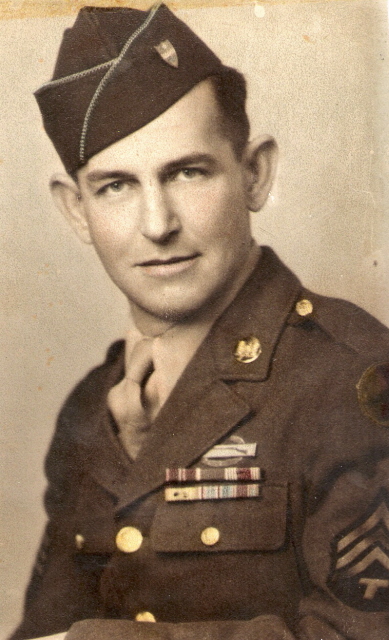
A Father's Day Tribute to My Dad

Peter Maddock, US Army, WWII
Dad, my Dad, where have you gone?
I once walked by your side.
My two small steps could never match
Your slow, but gentle stride.

My small hand in yours would rest; 
You were a giant then.
But yet so patient, yet so kind--
My hero among men.

Dad, my Dad, where have you gone?
Your lap was once my throne;
Your hair a crown of grizzled black,
To gray when I had grown.

Dad, you shouldn't work so hard,
You're getting much too thin.
Go out and shoot a round of golf,
Take me--for sure, you'll win.

Father, dear, I'm far away,
I need a loving hand
To slip me change when I go broke
And gently reprimand.

Dad, my Dad, where have you gone?
My son walks by my side;
His two small steps will never match
Your slow, but gentle stride.

I wrote this poem in the college library the summer of my freshman year.  Dad died a little over two years later, a semester before I graduated, and was buried on my twentieth birthday. Dad, you're still my hero. I love you, and I miss you.

My Father's Lap

In the shadow of thy wings I will take refuge, till the storms of destruction pass by.  – Psalm 57:1 (RSV)

     
When I was growing up, there was only one place where I could escape my mother’s wrath—my father’s lap. I was an impulsive child, and my mother wasn’t blessed with patience, so when our wills clashed, sparks flew.
     
Mom was the firestorm; Dad the quiet stream. I loved them both, but it was to Dad I turned when I needed a listening ear or when I just needed cuddled. Curled up in his lap, resting my head on his shoulder, feeling his arms around me, was the safest place in the world.
     
Fast forward forty years. I am now a mother, still a bit impulsive, fiery when I get going. My husband is like my father—a soothing balm to my blistering heat. One of my children has impulsively done something that could cast a dark shadow over the future. I am so furious, I shake. I feel heat radiating from my face.
     
“How could you do this?” I shout. “When we get home, you will tell your father what you’ve done.”
     
But the scene doesn’t turn out as I expect. There, curled up in my husband’s lap, is our errant, remorseful child.
     
Fast forward eight more years. I am now a grandmother. As my family has multiplied, so have my love and concern. I pray for my children and grandchildren every day, but still I worry. I am at the age where I realize how fragile life really is and how dangerous a place the world is. I have much more to lose now.
     
As I sit in the family room, my head rests on the wing of the love seat where I’m curled up. Eyes closed, I imagine myself sitting in my heavenly Father’s lap, resting my head on His shoulder, feeling His arms around me.
     
I speak no words, but peace, like a placid stream, gently seeps into my soul. I am in the safest place in the world.
     
     
Abba, Father, thank You for Your unconditional love. Amen.

Special-Tea: Psalm 57

Sunday, June 12, 2011

The better bone

A heart at peace gives life to the body, but envy rots the bones. – Proverbs 14:30 (NIV)
   
One morning years ago I gave each of our dogs, Bobby and Charlie, a big, juicy venison bone before I sat down for my devotions.

There, I thought smugly as they settled on the living room carpet about six feet from each other, that’ll keep them quiet and occupied for awhile.
   
I sank down into the love seat and opened my Bible to the day’s meditation. After a few minutes, Bobby got up, dropped his bone on the carpet at my feet, and stood over Charlie until she let go of hers. Quickly, he snapped it up and scooted behind the love seat. Charlie was too surprised to growl.
   
I didn’t want a dog fight in the middle of my living room, so I picked up Bobby’s bone and gave it to Charlie. It wasn’t long before Bobby sneaked out from behind the love seat and, once again, snatched the bone Charlie was chomping on. I took the bone that Bobby had left and dropped it in front of Charlie. Catching on to Bobby’s thievery, Charlie left the bone I gave her and went after Bobby’s.
   
On and on the swapping went, each dog acting as though the other had the better bone. What I thought would make for peace, instead became a source of envy and caused trouble.
   
I, too, battle envy. When a friend drives by in a new vehicle, suddenly my 1997 Explorer looks rustier and rattles (more like klunks) more loudly. After I’ve visited with someone who has a nicer house than I have, it seems as though the furniture and carpeting in my house have gotten shabbier overnight. And it’s all too easy to find fault with those who I feel are smarter, thinner or more talented.
   
Nine of the Ten Commandments deal with our actions; the tenth deals with our inner desires: “You must not be envious of your neighbor’s house, or want to sleep with his wife, or want to own his slaves, oxen, donkeys, or anything else he has” (Exodus 20:17 LB).
   
Like an acid, envy eats away at my peace of mind, my inner joy and contentment, and my relationships with others. No wonder God tells us to rid ourselves of envy (1 Peter 2:1). He knows what I’m still learning – that love, not envy, is the better bone.
       
When I feel that tug of envy on my heart, O Lord, help me to be satisfied with what I have, for everything I have is a gift from You. Amen.

Special-Tea: Matthew 6:19-33; Psalm 119:145-160

For further study: Hebrews 13:5; Philippians 4:11-13; James 1:17; Psalm 145:14-21; 1Timothy 6:9-11; Colossians 3:5; Matthew 15:19-20.

Sunday, June 5, 2011

Murder by mouth

You shall not murder. – Exodus 20:13(NIV)

When I was in college, my friends and I planned a surprise birthday party on our dormitory floor for our friend “PV.” Since we had to wait for her to return from some contrived errand, I decided to spend a few quiet moments with my boyfriend in the downstairs social room.
     
About the time PV was to have come back, Tammy, one of the party planners, approached me.
     
“PV isn’t back yet,” she said, “but I’ll let you know as soon as she comes.”
     
Then she went upstairs and told the girls, including PV, who had returned, that I said I didn’t want to come. After that I had no friends.
   
Murder by mouth. With her lie, Tammy destroyed precious friendships, my reputation, and what little joy I found in college.
     
The tongue, James wrote, “is a small thing, but what enormous damage it can do. . . It is full of wickedness that can ruin your whole life. . . It is an uncontrollable evil, full of deadly poison.”
     
The tongue is sharper than any knife, slicing into the aorta of someone’s character with malicious gossip and causing a reputation to bleed to death. Maybe that story we’re repeating is true, however unkind. But does it build up or tear down?
     
“With his mouth,” the writer of Proverbs notes, “the godless destroys his neighbor” (Proverbs 11:9).
   
But lies, slander and gossip aren’t the only ways we murder with our mouths. We are adept at destroying dreams, too.
   
We tell our kids to “aim for the stars,” then shoot them down when they do. A high school athlete dreams of being a major league ballplayer. A young girl aspires to be an astronaut. A want-to-be writer wrestles with putting a sentence together. A learning- disabled student dreams of becoming a teacher. Do we support them in their pursuits, unlikely as their dreams may seem to us? Or do we “bring them down to reality” with words that are meant to “soften the landing”?
   
Who knows, maybe that aspiring ballplayer will be the one in 10,000 who will make it to the big leagues. Perhaps that young woman will walk on the moon someday – or discover another star. Or that aspiring writer will win a Pulitzer Prize. And the student who struggles will become the best teacher because he understands and knows how to help.
   
Words can kill joy, too. Have you ever said something to someone and watched the light die out of their eyes? Maybe your husband did the laundry and you complain that the clothes aren’t folded right. Or perhaps your daughter cleaned the kitchen or your son washed your car, and instead of telling them you appreciate their efforts, you find the places they missed. Or maybe your wife went out of her way and took time, in spite of a busy schedule, to cook your favorite meal and you comment that the meat is a “little tough.”
   
“Do to others what you would have them do to you,” Jesus commanded us (Matthew 7:12). That includes our speech: “Say to others what you would have them say to you.” Framing our words in a positive manner means applying the Philippians 4:8 rule to our speech: Say only the words that are true, noble, right, pure, lovely, admirable, excellent and praiseworthy.
   
Words can bring death or life. The choice is ours.
   
Let everything you say be good and helpful, so that your words will be an encouragement to those who hear them. – Ephesians 4:29 (NLT)

Let me always be an encourager, Lord. Amen.

Friday, June 3, 2011

Taking inventory

Make every effort to add to your faith goodness, and to goodness, knowledge; and to knowledge, self-control; and to self-control, perseverance; and to perseverance, godliness; and to godliness, brotherly kindness; and to brotherly kindness, love.  – 2 Peter 1:5-7 (NIV)


Of all the end-of-the-school-year jobs I have, I dread taking inventory the most. But knowing what I have and what I don’t have will make things easier when the new school year rolls around.

Taking spiritual inventory regularly is important, too. God’s Word tells me what I should have on my spiritual shelves:

Faith, believing that God exists and what He says in His Word is true, is most important. Without faith, nothing else on my shelves has meaning. Faith is “being sure of what we hope for and certain of what we do not see” (Hebrews 11:1). I have faith that I have a home in heaven when I leave this earth. I have faith that God is with me at all times, living in me in the form of His Holy Spirit.

 Another important item is goodness. On my own, I can’t be good. I trip over my faults daily. The goodness St. Peter wrote about is God’s goodness. The New King James Version uses the word “virtue” – or “excellence in character and conduct.” Through the Holy Spirit’s power, I can live a life worthy of the price God paid for me on Calvary.
 
Knowledge of God is another item I need to keep in stock. How can a finite, limited human being ever begin to know the infinite, unlimited God? By reading and believing His Word. By talking to Him as though He were right beside you every moment of the day – He is, you know – and listening to Him when He speaks to you.

I tend to run out of self-control quickly because I use it frequently. Keeping guard of my thoughts, words and actions isn’t easy. I need to remember to stop and think before I act or speak. I need to open a package of “What Would Jesus Do?” daily.

Perseverance is sticking with something no matter how hard it gets. I’m not a good fighter. When the going gets tough, I’d rather turn tail and run. Discouragement and despair rule the day. Sometimes God sends a package of perseverance in the form of an encouraging friend.

If being good on my own is hard, then being godly is near impossible. Godliness – living my life so that I reflect God’s character – can be achieved by studying and meditating on Scripture, letting it soak into every fiber of my being. If I am to reflect God to the world, like a mirror reflects the sun, then I must turn my face to His Son.
 
Brotherly kindness and love go hand in hand. Sometimes it’s hard to love others, to be kind to those who are unkind. But I can practice kindness by choosing to treat others with respect, the way I want to be treated. By answering softly, and sometimes, biting my tongue and not answering at all. By refusing to dwell on the things that others say and do that irk me. By focusing on the rose and not the thorn in another’s personality.

And, finally, I need to keep a good supply of love on hand. Not human love because it’s used up too quickly, but divine love – letting God love others through me. Calvary tells me that everyone has worth in God’s eyes. Love with a tag of “sacrifice” on it is the kind of love God wants me to have for others.

Help me, Lord, to keep my shelves stocked with You. Amen.
Special-Tea: 2 Peter 1:5-11